
Article: Engagement ring: choosing a unique ring, from the stone to the metal
Engagement ring: choosing a unique ring, from the stone to the metal
An engagement ring is chosen in a few weeks and worn for a lifetime. It will be there for the first morning coffee, in hands reaching for each other, in family photos that will be looked at thirty years from now. It is perhaps the only piece of jewelry we choose with the certainty that it will never leave us.
At the workshop at 81 rue des Martyrs, engagement projects arrive in a thousand ways. Someone comes alone, in secret, with a ring discreetly borrowed to measure its size. A couple pushes the door together, already engaged, to choose the stone as a pair. Another time, it is a grandmother's diamond waiting for its new setting. And behind every project, the same question: what will the ring that says "yes" look like?
This article accompanies this choice, step by step: the stone, the metal, the setting, the wedding band that will follow, the finger size, the budget. And what makes an engagement ring, beyond the promise, also possess a character of its own.
An engagement ring: a promise, and a character
For a long time, the engagement ring had a nearly imposed design: a white, round diamond held by four or six prongs. The classic solitaire has its beauty, and it remains an obvious choice for many. But an engagement ring carries more than just a commitment. It also carries the person who receives it: their style, their way of life, their hand.
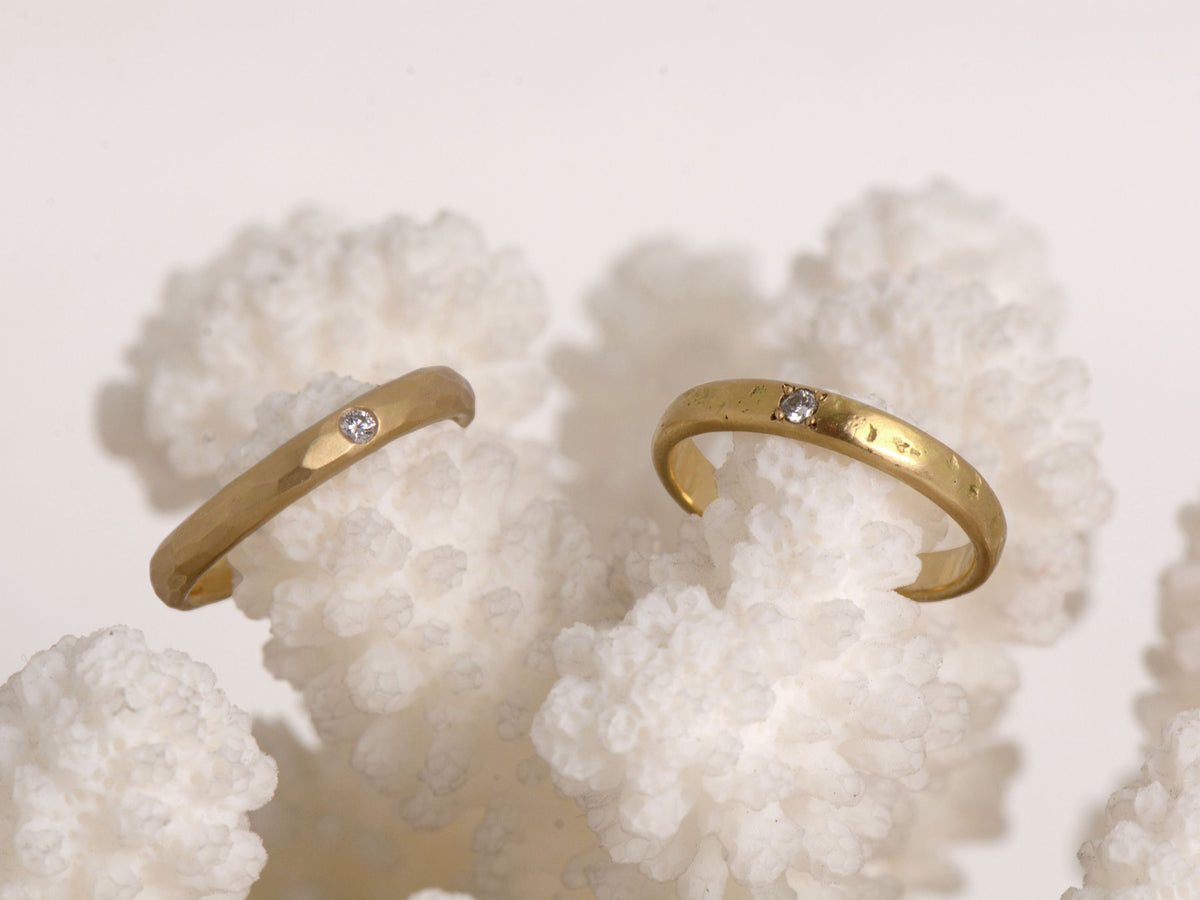
This is why our engagement rings gladly move away from the expected solitaire to explore other shapes: rose-cut or antique-cut diamonds, bezel settings, hammered gold, colored stones. Rings that seem to have already lived several lives, yet are now beginning yours. A unique engagement ring, in short, rather than just another engagement ring.
Choosing the stone: beyond the round diamond
The stone is often the starting point, and this is where the choices are most open.
The rose-cut diamond. This is one of the oldest cuts in jewelry, dating back to the 16th century. Its base is flat, and its top forms a dome of triangular facets, without the deep point of modern cuts. The result: the rose-cut does not sparkle, it glows. Its light is soft, almost liquid, and because the stone is shallow, it appears larger for the same weight. It is one of the workshop’s favorite cuts, seen in the Syracuse or Sagan rings.
The antique cut. Before the machine age, diamonds were cut by hand. Antique cuts, such as the old cushion cut, bear the marks of this: wider facets, less perfect geometry, and light that scatters in broad flashes rather than tiny sparks. An antique cut brings a depth of time to a new ring, as seen on the Mon Chéri antique cushion-cut diamond ring.
Other shapes. Oval, marquise, cushion, round: each shape shapes the hand differently. The oval and marquise elongate the finger, the cushion softens, and the round remains the most timeless shape. Champagne diamonds, with their warm reflections, are particularly well-suited to yellow gold.
Colored stones. Indigo tourmaline, aquamarine, sapphire, emerald, spinel: a colored stone makes an engagement ring a deeply personal object, chosen for a hue rather than a standard. A word of caution, however, for a ring that will be worn every day: not all stones age in the same way. Diamond and sapphire are among the most resistant. Tourmaline and aquamarine require a bit more care; the emerald, often rich in inclusions, requires even more precautions in daily life. This is one of the reasons why the workshop favors the bezel setting.
Finally, carat weight doesn't tell the whole story. The right stone is the one that finds its balance with the hand that will wear it: on a slender hand, a small, well-proportioned rose-cut can have more presence than a stone twice as heavy.
Yellow gold or platinum: choosing the metal
Our engagement rings are crafted in 18-karat gold (750/1000) or 950 platinum. Two noble metals, two characters.
Yellow gold is warm, luminous, and timeless. It highlights the softness of a rose-cut, the reflections of a champagne diamond, and the intensity of colored stones. It is the most prominent metal in our engagement ring collection.
Platinum is denser than gold and particularly suitable for jewelry worn every day. Its white color is natural and does not depend on rhodium plating. Over the years, it develops a matte patina, made of the fine marks of daily life, which some people specifically seek out. It is our metal of choice for rings worn for decades: engagement rings and wedding bands. It particularly enhances white diamonds.
White gold is another option for those who like white metal; it simply requires re-plating with rhodium every three to five years, depending on wear.
A workshop tip: think about the metal of the future wedding band now. The choice of metal, shape, and finish for both rings allows you to anticipate how they will live together when worn side-by-side.
The bezel setting and hammering: the workshop's signature
Where most engagement rings hold their stones with prongs, we favor the bezel setting: the stone is surrounded by a fine ring of metal that protects its entire perimeter. For a ring worn every day, this is a truly practical choice: no prongs to snag on a sweater or hair, edges protected from impacts, and a stone held securely in place. It is also a demanding setting that requires great precision, especially on rose-cuts with irregular contours.
Then comes the surface. Hand hammering, the house signature, is done piece by piece, without a template: no two rings are strictly identical. The metal catches the light differently depending on the angle, and the patina enriches over the years. A hammered ring does not fear the little marks of daily life; it absorbs them. Other textures make up the workshop's vocabulary: gold granules, checkered or striated patterns. Our craftsmanship page details these techniques.
Thinking of the engagement ring with the wedding band
In France, the engagement ring and wedding band are most often worn together on the left ring finger. It is best to think of them together from the start. The height of the setting, the width of the band, and the shape of the stone determine whether the wedding band will sit flush against the ring or if they will leave a slight space between them.
Some combinations are obvious: a delicate solitaire with a thin diamond-set band, like the Sita Baby, or a stone ring with a simple hammered band. Others are found at the workshop by trying the rings side-by-side on the hand. Our wedding bands share the metals and textures of our engagement rings: they were made to find each other.
Collection piece or bespoke creation?
There are several paths to finding your engagement ring at the workshop, and they often cross.
Choosing a collection piece. Every ring already exists, with a stone selected by Emmanuelle. For gold and platinum models, it is possible to choose the center stone, subject to availability, and all finger sizes can be made. This is often the simplest path for a surprise proposal. Many couples also choose their ring together after the proposal: it’s another way to start the story.
Creating a bespoke ring. The ring is designed for one person: the metal, the stone, the proportions, the texture, the engraving. The project is built over a few weeks in three stages: the meeting, the selection, the crafting. We have told this story in detail in our article on bespoke jewelry.
Resetting a family stone. This is perhaps the most moving of engagement rings: a grandmother's diamond, a stone from a ring no one wore anymore, reset in a new mounting. Today's promise then rests upon yesterday's memory, and the stone continues its journey on the finger of a new generation.
Knowing the finger size… without raising suspicion
This is the question that comes up most often before a surprise proposal. A few workshop tips:
- Borrow a ring. Choose a ring worn on the ring finger, ideally on the left hand: the fingers on the dominant hand are often slightly larger. Bring it to the workshop or measure its inner diameter using our size guide.
- Keep a trace. If the ring cannot leave its jewelry box, place it on a piece of paper and trace its inner outline with a fine pencil, or press it for a few seconds into a piece of modeling clay.
- Ask a loved one. A sister, a friend, or a mother sometimes know the size or know how to discover it discreetly.
And if the size isn't quite right, don't worry: for gold and platinum models, resizing is often possible after the proposal, depending on the model.
What budget for an engagement ring?
The famous "two months' salary" rule is not a tradition at all; it is an advertising invention from the last century. The right budget is one that allows you to propose with peace of mind, without the ring becoming a burden.
At the workshop, engagement rings start around €550 for a Baby Solitaire—a thin band and a small diamond in a bezel setting—and go up to several thousand euros for a diamond of over a carat, as seen on some Syracuse rings.
The price depends on several factors: the stone (its weight, cut, quality), the metal (platinum, being denser, weighs more for the same volume), the complexity of the mounting, and the workshop labor. For a bespoke creation, a quote is provided at the first meeting. And when resetting a family stone, or reusing old gold, that material is factored into the quote calculation.
Frequently asked questions about engagement rings
How to choose an engagement ring?
Start with the person who will wear it: their style, their everyday jewelry, and their way of living with their hands. Then choose the stone (rose-cut diamond, antique cut, or colored stone), the metal (18k gold or platinum), and the setting. Finally, think about the wedding band that will be worn next to it.
What budget should I plan for an engagement ring?
There is no rule: the "two months' salary" rule is an advertising invention. At the workshop, engagement rings start around €550 and go up to several thousand euros, depending on the stone, the metal, and the complexity of the piece. For a bespoke creation, a quote is provided at the first meeting.
Gold or platinum for an engagement ring?
Both are noble and durable metals. 18k yellow gold is warm and luminous; it enhances rose-cuts and champagne diamonds. 950 platinum, denser than gold, maintains a natural whiteness: it is our metal of choice for rings worn every day. If both rings are worn together, it is best to consider their metals, shapes, and finishes from the start.
How do I find out the finger size for a surprise proposal?
Discreetly borrow a ring worn on the ring finger, preferably the left hand, then bring it to the workshop or measure its inner diameter with our size guide. For gold and platinum models, resizing is often possible after the proposal.
Can I choose my own stone?
Yes, for gold and platinum models. Emmanuelle assists with the selection from her gem dealers, depending on availability, the nature of the stone, and the ring model. As every stone is unique, shades may vary slightly.
Can I create an engagement ring with a family stone?
Yes, resetting a family stone is part of the workshop's bespoke work. The stone is examined first, and then a new mounting is designed around it: its size and shape often guide the ring's design. The gold from the original piece can also be reused.
How long does a bespoke engagement ring take?
Expect generally a few weeks, from the first meeting to delivery, depending on the project's complexity. If the proposal is planned for a specific date, it is better to plan ahead.
Can I engrave an engagement ring?
Yes. A date, initials, a word, or a Latin motto engraved inside the band makes the ring a shared secret between the giver and the wearer.
Key takeaways
Remember: a successful engagement ring is:
a stone chosen for its character, whether rose-cut, antique-cut, or colored,
a metal designed to last, 18k gold or platinum,
a bezel setting that protects the stone in daily life,
a ring imagined from the start with the wedding band that will join it,
a finger size obtained in secret, and adjustable if needed,
a collection model or a bespoke creation, sometimes built around a family stone.
An engagement ring is not judged by its carat weight. It is judged years later, by how it has aged with the hand that wears it, by the marks it has kept, by the stories it tells without saying a word. It is for that life that we design them: rings that begin with a promise and one day become an heirloom.
Are you planning a proposal? Discover our engagement rings, or make an appointment with Emmanuelle at the workshop, at 81 rue des Martyrs in Montmartre. Are you far away? Write to us on WhatsApp for an initial exchange.
Emmanuelle Zysman has been imagining and crafting jewelry in Paris since 2004, in her Montmartre workshop at 81 rue des Martyrs. Her engagement rings, in 18k gold or platinum, favor rose-cut and antique-cut diamonds, bezel settings, and hand hammering: rings designed for a lifetime, and for the generations to follow.


